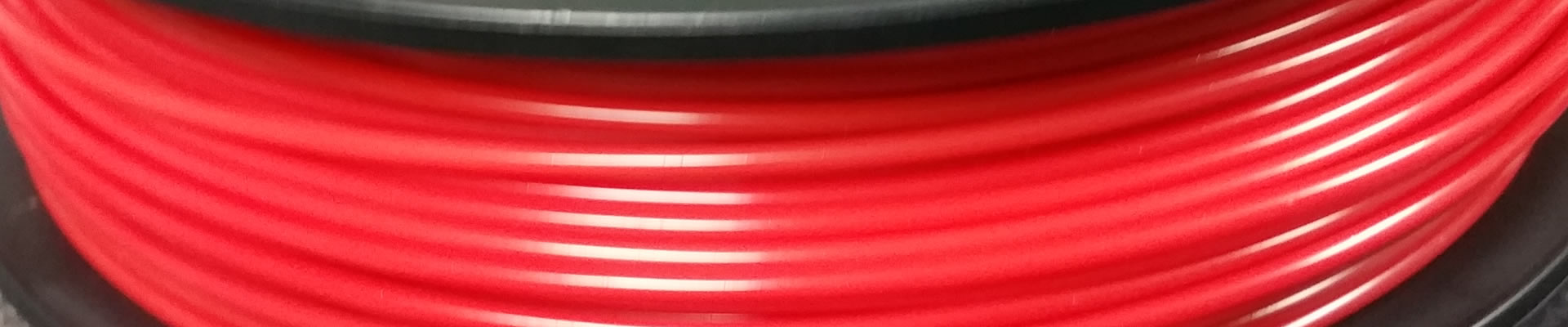
We can supply :
We specialise in developing new or tailor made grades in partnership with our customers' individual requirements.
Polytetrafluoroethylene (PTFE) is a synthetic fluoropolymer of tetrafluoroethylene consisting wholly of carbon and fluorine. It is a thermoplastic polymer, which is a white solid at room temperature. PTFE is hydrophobic: neither water nor water-containing substances wet. It has one of the lowest coefficients of friction against any solid and is very non-reactive.
It is often used in containers and pipework for reactive and corrosive chemicals. Where used as a lubricant, PTFE reduces friction, wear, and energy consumption of machinery. It is often used for bearings, gears, slide plates and seals especially in high temperatures where liquid lubricants and greases would be less effective or inapplicable. PTFE is used as a non-stick coating for pans and other cookware. In it's porous, expanded form, it is used for breathable membranes, for example clothing and filters.
For the chemists and chemical engineers amongst you :
The structural formula is
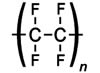
and a molecular model would look like this
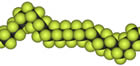
The proper name is actually poly(difluoromethylene), but nobody ever uses that. Some typical properties :
| Property | Value |
| Density | 2200 kg/m³ |
| Melting point | 327 °C |
| Young's modulus | 0.5 GPa |
| Yield strength | 23 MPa |
| Coefficient of friction | 0.05-0.10 |
| Dielectric constant | ε=2.1,tan(δ)<5(-4) |
| Dielectric constant (60 Hz) | ε=2.1,tan(δ)<2(-4) |
| Dielectric strength (1 MHz) | 60 MV/m |
Note that we supply a vast range of PTFE and PTFE blends where many of these properties are highly modified to suit the applications.
PTFE is the only known surface that a Gecko cannot adhere too,
(and not a lot of people know that !)
PTFE has excellent dielectric properties. This is especially true at high radio frequencies, making it suitable for use as an insulator in cables and connector assemblies and as a material for printed circuit boards used at microwave frequencies. Combined with its high melting temperature, this makes it the material of choice as a high-performance substitute for the weaker and lower melting point polyethylene that is commonly used in low-cost applications.
Because of its chemical inertness, PTFE cannot be cross-linked like an elastomer. Therefore, it has no "memory" and is subject to creep, (or cold flow). This is advantageous when used as a seal, because the material creeps a small amount to conform to the mating surface. However, to keep the seal from creeping too much, fillers are used, which can also improve wear resistance and reduce friction.
PTFE can also be used to coat or impregnate other substrates like glass fibre to enhance their properties.
PTFE is also widely used as a thread seal tape in plumbing applications, largely replacing paste thread dope.
W.O. PTI Ltd, Units B/C, Aak Industrial Estate, Falcon Street, Oldham OL8 1JUCopyright © 2026 W.O. PTI Ltd